What is Banned Books Week?
Banned Books Week is a yearly campaign that brings awareness to banned and challenged books and celebrates the freedom to read. You can find out more about Banned Books Week at bannedbooksweek.org. This year’s theme is “Censorship Is So 1984 – Read for Your Rights.”
This year, the Honorary Chair of Banned Books Week is George Takei.
According to PEN America, there were 6,870 book bans “affecting nearly 4,000 unique titles” in the 2024-2025 school year. If you’re interested in learning more (or finding out what the most banned books are), you can read about it on PEN America’s Banned Books List page.
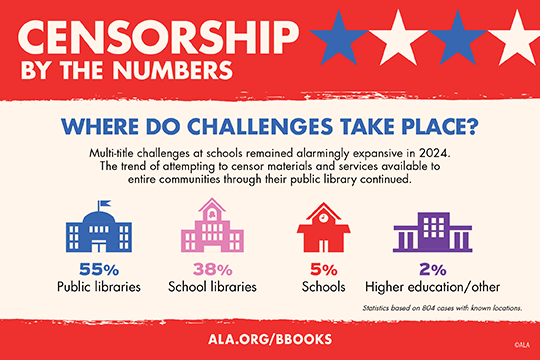
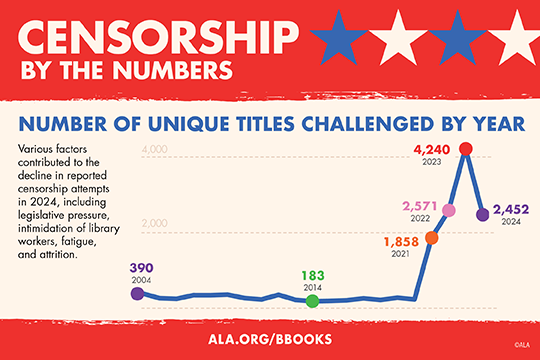
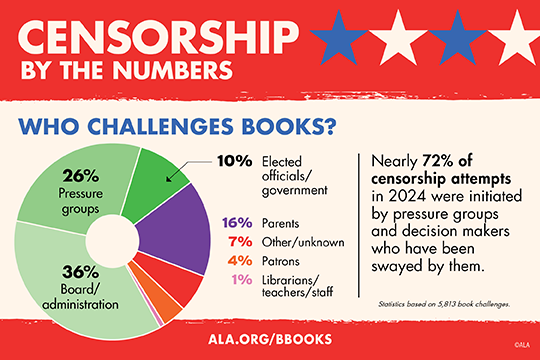
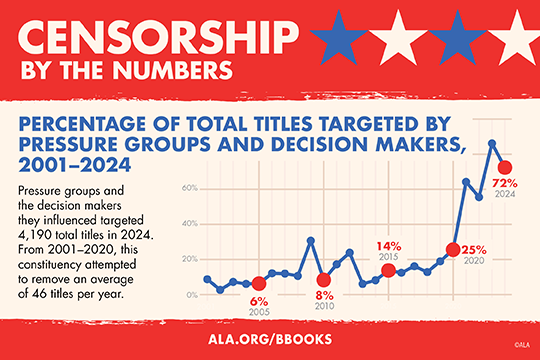
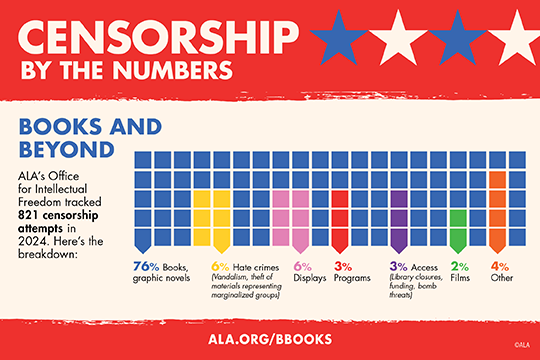
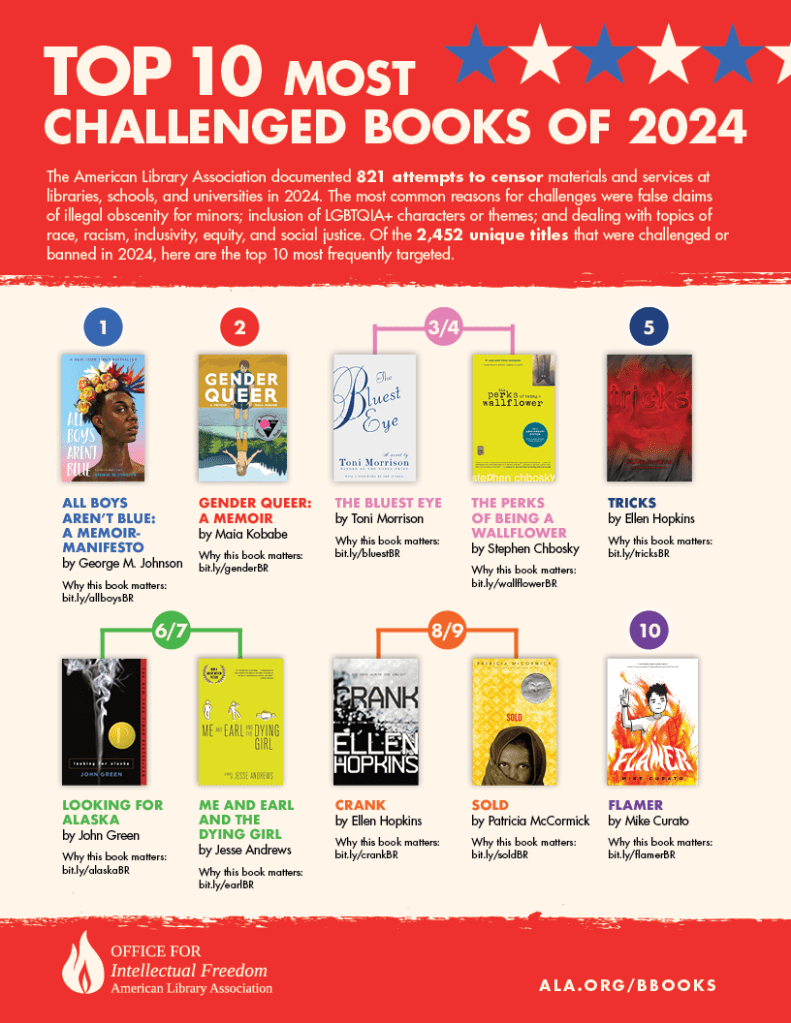
The American Library Association has a lot of great information about book bans, as well! See some of their infographics below!
How Is TBR Books Participating?
As part of our celebration of Banned Books Week, we will be featuring some of the banned books we have in store each day! You can check this space or our blog each day for a new book.
If we don’t have your favorite banned book, it’s because we have very limited space, but we are happy to order it in for you! Just let us know what you’re looking for and make sure we have your name and number.
Our banned book features are below, and sources are linked when used.
Featured book for 10/5:
1984
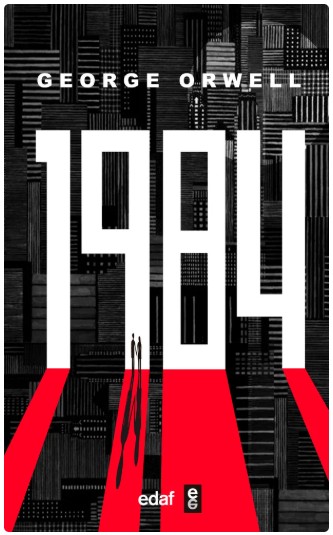
1984 by George Orwell is a very well-known dystopian novel originally published in 1949 about a fictional future controlled by a totalitarian regime known as Big Brother. Big Brother uses propaganda, surveillance, and Thought Police to control the populace.
1984 is often referenced when discussing the dangers of mass surveillance, authoritarianism, and limiting freedom of expression. Many of the terms used in this book to describe the control and manipulation of the population (“thoughtcrime,” “newspeak,” “doublethink,” and even “Big Brother”) have become commonplace. When people refer to something as Orwellian, they are referring to the circumstances in this book.
Where and why was 1984 banned?
According to The Banned Library, it was banned from 1950-1990 in the Soviet Union for being anti-communist. Yet, it was also banned in 1981 in Jackson County, Florida, for being pro-communist and “containing ‘explicit sexual content.’” It was challenged by a parent in Idaho in 2017 for “violent, sexually charged language.”
LegalClarity states that when 1984 was banned in the Soviet Union, it was also banned in Cuba for being a “threat to the established political system.” Most interestingly, “some challenges stemmed from the book’s perceived anti-government messages or its potential to encourage students to question authority.“
If you’re interested in picking up 1984 from TBR Books, we currently have it in our Fiction section, near the front of the store.
Featured Book for 10/6: They Called Us Enemy
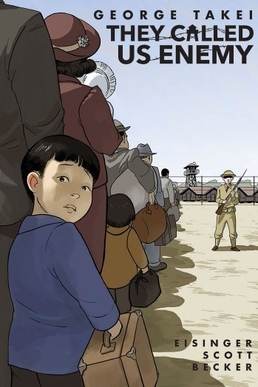
Since George Takei is the honorary chair of Banned Books Week, it is only right that we include one of his books in our featured list! They Called Us Enemy is an autobiographical graphic novel by George Takei, Justin Eisinger, and Steven Scott, and illustrated by Harmony Becker.
The book details Takei’s childhood in an internment camp during World War II and has won multiple awards.
If you’re unfamiliar with what the internment camps were, that’s okay. There is always so much history to learn that it’s almost impossible to take it all in or retain everything. You can learn about them now!
During World War II, Japanese Americans had their movements restricted and then were rounded up and put into camps out of fear that they might betray the United States. Not everyone agreed that this was a good (or constitutional) idea, and it has obviously had a lasting impact on the people who were forced to live in the camps. You can learn about the internment camps in detail through the Encyclopedia Britannica, which has a very thorough article about them. You can also read about them at the National World War II Museum, the National Archives, or the National Museum of American History.
If you’re worried about how this part of US history might affect your understanding or relationship with the United States, you can watch this TED Talk in which George Takei describes both the traumatic reality of his internment camp experience, what happened after they were released, and what it means to be American.
Where and why was They Called Us Enemy banned?
It was banned at the Central York County School District in Pennsylvania in 2020 for discussing racial issues, but the ban was rescinded in 2021.
If you want this book, we have it in our Graphic Novels section, which is located in the Children’s room.
Featured Book for 10/7: Willow Wonders Why Do I Worry?
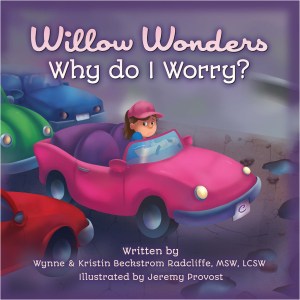
Willow Wonders Why Do I Worry is written by Wynne & Kristin Beckstrom Radcliffe, MSW, LCSW and illustrated by Jeremy Provost. It is a short children’s book that compares living with OCD (Obsessive Compulsive Disorder) to driving a car on an ever-changing map. Sometimes the road is clear, and sometimes it is full of obstacles.
OCD can be debilitating. The book has an introduction geared toward parents and educators that explains what OCD is, that it can exist alongside other disorders, and that children experience it differently than adults do. At the end of the book, there are brief bios for the authors and illustrator and a list of resources and other helpful books that talk about OCD.
One of the authors, Wynne, is an 11-year-old who deals OCD herself.
Where and why was Willow Wonders Why Do I Worry banned?
It has been banned in Tennessee for discussing mental health issues.
If you want to buy this book, we have signed copies in our Local Interest section because the authors are in the area!
Featured book for 10/8: Maus I and Maus II
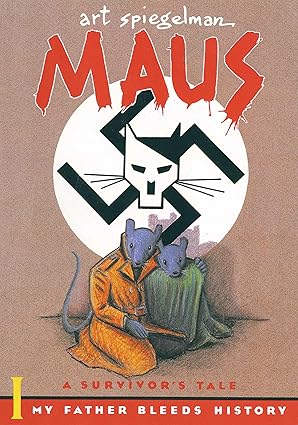
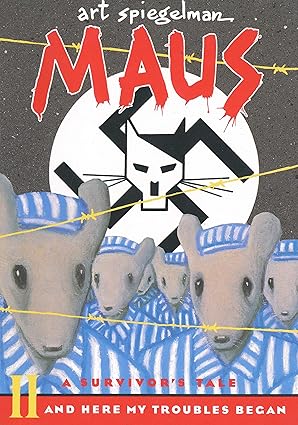
Maus I, published in 1986, and Maus II, published in 1991, are graphic novels by Art Spiegelman. They detail his Jewish parents’ experiences during and after the Holocaust. They had lived in Poland in the 1940s until Nazis sent them to Auschwitz, one of the most infamous concentration camps. During the Holocaust, Nazis murdered around six million Jews. In the graphic novels, Holocaust victims are represented as mice, Nazis as cats, and non-Jewish Polish people as pigs.
The book itself was revolutionary: comics did not usually portray heavy subjects, especially in such a serious manner. The book also depicted not just the initial trauma of Holocaust victims but the way the Holocaust continued to affect subsequent generations.
If you’re unfamiliar with the Holocaust, now is the perfect time to learn about it. The Holocaust was a significant part of World War II and resulted in the deaths of 6 million European Jews, as well as 5 million others, including Romani people, disabled people, gay people, and political dissidents including communists and socialists.
For a quick overview, History.com presents a fairly thorough and easy-to-read article. So does the Encyclopedia Britannica. The United States Holocaust Memorial Museum has a detailed Holocaust Encyclopedia if you’d like to go on a deep-dive. You can also check out the National WWII Musuem. The Jewish Virtual Library is a fantastic resource. We aren’t talking about the Diary of Anne Frank this Banned Books Week (although that, too, has been banned), but the Anne Frank House is another good museum and resource for learning about the Holocaust.
To understand the concentration camp that Spiegelman’s parents were sent to, please visit the website for the Auschwitz-Birkenau Museum, which is located at the site of the former Nazi Concentration and Extermination Camp.
In 1992, Maus won a Special Awards and Citations Pulitzer Prize.
Where and why was Maus banned?
It was challenged in Germany due to the swastika on the cover, since swastikas are not allowed to be displayed except “in works of serious historical research,” so the book was recategorized to allow it to be published there.
It was booed at an event in Israel because the comic book medium seemed disrespectful to the subject matter.
In 2001, Maus was translated into Polish, and an angry crowd burned the book in front of the publisher’s office. In the book, Poles are depicted as pigs.
In 2012, the book was challenged by a Polish American in Pasdena, California.
Maus was banned in Russia in 2015 because of the swastika on the cover, which violates a law regarding Nazi propaganda. Obviously, the book does not utilize the swastika in support of Nazism, but the swastika is considered propaganda regardless.
In 2022, it experienced a number of challenges and bans. It even experienced a book burning within the United States.
It was challenged at Indian River County School District in Florida and Katy Independent School District in Texas.
It was banned pending investigation in Wentzville School District in Missouri and banned outright in Ritenour School District in Missouri for being sexually explicit. In Wentzville, the book was returned to school shelves.
On February 2, 2022, Maus was burned as part of a book burning event organized by Greg Locke, a pastor in Tennessee.
It was also removed from the 8th grade curriculum in McMinn County, Tennessee, in early 2022 due to profanity and nudity, although a school board member also mentioned violence. Before banning the book, the Board discussed only redacting objectionable material but decided that might result in copyright violations. Reportedly, some members of the McMinn County Board of Education objected to the scenes in which the mice stripped off their clothes at the concentration camp, as well as the “rough, objectionable language in this book,” and the vote to ban it was unanimous. There are only 8 curse words which were objected to. One of the board members asked why the educational system would “promote this kind of stuff” in reference to violence and suicide in the book. He also said that they “don’t need to enable or somewhat promote this stuff.”
In 2023, Maus was challenged in Nixa, Missouri, but it was ultimately not banned.
You can read an interview with Art Spiegelman disscussing the bans here.
If you’re interested in buying Maus I or Maus II, we have been keeping them in our Classics section, near the front of the store.
Featured Book for 10/9: The Bluest Eye
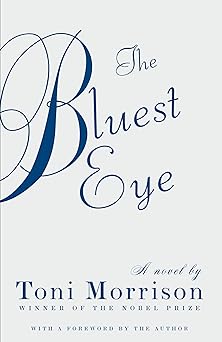
The Bluest Eye is a novel written by Toni Morison and published in 1970. It is about an 11-year-old African American girl in 1940s Ohio. She is from an abusive home and believes that having blue eyes will make her beautiful. The book looks at beauty standards, racial discrimination, white supremacy, economic disparity, child abuse, sexual violence, and sexism.
Toni Morrison won a Nobel Prize in Literature in 1993. The Bluest Eye was featured in Oprah’s Book Club in 2000.
The Bluest Eye is one of the most challenged books across the country and has been for years. The American Library Association lists it as tied for 3rd/4th most banned book in the last year, which you can see in the ALA graphics shared above. It was in the top 10 banned books from 2010-2019.
Buncombe & The Bluest Eye is a fantastic research project providing a resource for examining where and why The Bluest Eye was banned, leading up to its ban in Buncombe County, North Carolina, in 2017. They even have an interactive map!
The first challenge found by the project was in 1998 in Montgomery County, Maryland, for being too adult, but the book was ultimately not banned.
In 1999, it was banned from the high school in Baker City, Oregon for sexual content.
In 2004, it was challenged at Kern High School District in Bakersfield, California, for sexual content but ultimately not banned.
In 2006, it was banned from the curriculum and library in Littleton, Colorado for sexual content.
In 2007, it was challenged at the high school in Howell, Michigan, for sexual content.
In 2009, it was challenged at the high school in Delphi, Indiana, for sexual content.
In 2012, it was challenged in Brookfield, Connecticut, for sexual content and profanity.
In 2013, it was challenged at Legacy High School in Broomfield, Colorado, for sexual content and “lacking educational value.”
In 2014, it was challenged in Columbus, Ohio, for being inappropriate and having “an underlying socialist communist agenda.” The book was on the Common Core Standards reading list for 11th grade students in Ohio, but it was deemed “inappropriate for high school students because it uses explicit language and depicts rape and incest.”
Also in 2014, it was challenged in Wendell, North Carolina, for inappropriateness.
In 2017, it was challenged in Buncombe County, North Carolina, for sexual content and was moved from English III reading list to the AP English IV class reading list.
In 2020, teachers at Colton High School in Colton, California, were “banned from discussing the book with their students,” although the book was not removed from the school. It was unbanned several months later.
In 2021, it was removed from shelves in Canyons School District in Utah after it was challenged by a parent.
In 2022, it was the most banned book in Texas and the 3rd most challenged book in the country.
In 2023, the book was removed from the curriculum at Washinton Township High School in Gloucester County, Philadelphia for graphic content. The book had been a part of the curriculum since 2018. When it was removed, “one freshman English teacher had finished teaching the book.
Also in 2023, the Elizabeth School District in Elbert County, Colorado banned 19 books including The Bluest Eye, and the following year (2024), students and groups filed a lawsuit over the bans.
Here is a 1978 interview with Toni Morrison. In this interview, she talks about writing and life, and she also reads aloud from some of her work.
If you’re interested, you can read the NAACP’s statement about banning The Bluest Eye.
If you’d like to buy this book, we have it located in our Fiction section, near the front of the store.
Featured Book for 10/10: The Handmaid’s Tale
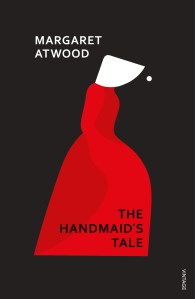
The Handmaid’s Tale by Margaret Atwood, published in 1985, features a protagonist who has been forced into being a surrogate mother in a totalitarian world where women have very specific roles and no rights. It addresses totalitarianism, patriarchy, gender roles, oppression, censorship, injustice, and what it means to be free.
It won the Governor General’s Literary Awards in Canada in 1985 and was shortlisted for The Booker Prize in 1986.
It was adapted into a film in 1990, an opera in 2000, and a ballet in 2013.
It became an award-winning television series on Hulu in 2017.
A limited unburnable edition of the book was created as a symbol against censorship in 2022 and was auctioned by Sotheby’s to support PEN America’s anti-censorship work.
The book and television series have become symbols of resistance to people dressing up as handmaids to protest restrictive abortion bills across the country.
Interestingly, the book was referenced by a judge in Georgia who struck down the state’s abortion ban, but the ban was later reinstated.
Where and why was The Handmaid’s Tale banned?
The Handmaid’s Tale has been frequently challenged or banned since its publication. Some of the reasons for bans include “accusations of the novel being anti-Christian and anti-Islamic due to veiled women, as well as being sexually explicit and graphically violent.”
It has been banned in Portugal and Spain for “sexual content, profanity, being anti-Christian, and featuring LGBTQ+ characters.”
The text was reportedly altered in the Persian translation in Iran to remove “all pro-feminist content.”
It was challenged at Lawrence Park Collegiate Institute in Toronto, Canada, due to “sex, brutal situations, murder, prostitution.”
It was one of the most challenged books from 1990 to 2019.
In 1992, it was challenged at schools in Waterloo, Iowa, due to “profanity, sexually explicit material, and statements considered defamatory to minorities, God, women, and the disabled.”
In 1993, it was banned at Chicopee High School in Massachusetts due to profanity and sexual content.
In 2006, it was banned (and then unbanned) in Judson, Texas schools due to its corrupting influence.
In 2013, it was challenged at Grimsley High School in Guilford County, North Carolina, due to denigration of Christianity and traditional values, but it was not banned.
In 2014, the book was banned by the Pennsylvania School Board, but the ban was rescinded a month later.
In 2021, it was removed from the Goddard School District in Wichita, Kansas.
In 2022, it was challenged in the state of Georgia during the hearing for SB 226, which was passed.
In 2022, the graphic novel was removed from libraries in Clayton, Missouri.
It has been banned or restricted in a significant number of counties (too many to justify listing here) in Florida since 2022.
In 2023, the book was banned from the high school library in Madison County, Virginia due to sexual content. Atwood published an article in response to the ban in The Atlantic. She argues that the Bible has more explicit scenes than her book and defends the book against accusations of it being anti-Christian.
In 2023, the graphic novel version was banned from the West Ada School District in Idaho. During graduation in 2024, one of the students in that school district attempted to hand a copy of the book to the Superintendent and dropped it on the ground at his feet when he refused to take it.
Also in 2023, the graphic novel version of the book was banned in Coweta County, Georgia.
In 2024, it was removed from school libraries at Council Bluffs Community School District in Iowa due to sexual content.
Also in 2024, the book was banned from all school libraries in the state of Utah.
Also in 2024, the book was removed from school libraries in Wilson County School District in Tennessee.
Still in 2024, it was banned at schools in Katy, Texas.
In 2025, it has been banned from schools and public libraries in Idaho due to the HB 710 law which restricts access to certain materials for minors.
In 2025, it was banned in Alberta, Canada due to sexual content. Atwood responded to the ban with a satirical short story.
You can read an interview with Margaret Atwood at the UK’s Penguin Random House website. Emma Watson interviewed her in 2017, and you can read that at Entertainment Weekly. NPR has a great interview with Atwood from 2024.
We have also found mulitple video interviews with Margaret Atwood. You can find them below.
- Margaret Atwood on gender, women’s rights, and Roald Dahl revisions – BBC News, 2023
- World ‘moving back towards “Handmaid’s Tale,”’ Margaret Atwood says – ABC News, 2022
- Margaret Atwood: ‘The Handmaid’s Tale is being read very differently now’ – Vintage Books, 2018
- Author Margaret Atwood on Writing The Handmaid’s Tale | The Embrace Ambition Summit – Tory Burch Foundation, 2018
If you’re looking for a copy of The Handmaid’s Tale, we have both the traditional and the graphic novel version in our Fiction section near the front of the store. We also have the print version of its sequel, The Testaments.
Let Freedom Read Day
10/11
The final day of Banned Books Week is Let Freedom Read Day, which the official Banned Books Week website says is a day of action.
They list actions you can take to help fight book bans based on how much time you have available! It’s a handy guide with helpful resources, and we recommend you check it out if you’re interested.
One of the ways you can fight book bans AND support TBR Books (as well as writers and publishers) is to buy a banned book! We have had a great turnout this week of people looking to purchase banned books, so we are running low or out of several of our banned titles, but we are more than happy to order more! Please drop in and let us know what you’re looking for, and if we don’t have it, we can order it for you.
Every action you can take to fight censorship and to support writers, publishers, and booksellers matters!
One great example of how small actions have added up to big success is the Illinois Library System Act, which became effective on January 1, 2024.
This law ensures that libraries adopt a statement like the ALA Library Bill of Rights, which will prevent materials from being “removed due to partisan or doctrinal disapproval.”
The American Library Association’s Library Bill of Rights is a guideline of policies and principles that help guide librarians in collections and services decisions.
The Illinois law helps push back against pressure to ban books from school and public libraries and keeps small special-interest groups from determining what the entire community has access to.
Additionally, the bill ensures that library services are expanded and “that libraries are provided for all citizens of Illinois,” and that libraries have enough librarians and adequate materials for reference and research.
It’s the first time a bill like this has been passed.
The bill also includes funding “to build Dolly Parton’s Imagination Library as a state-wide program,” ensuring that children from birth to age 5 “receive high-quality books mailed to them at no cost, no matter their income.”
This bill is a very clear win for libraries, education, literacy, and the fight against censorship and book bans.
You can read more about this law at Law&Crime or at BanBookBans.
 TBR Books